
Most people overcomplicate their CV.
Fancy design.
Creative sections.
Long paragraphs.
And then wonder why they hear nothing back.
Here’s the truth from the hiring side:
Recruiters don’t want to “discover” your story.
They want to scan and decide in 10 seconds.
If they can’t instantly see:
- what you do
- your level
- your impact
- your relevance
You’re out.
Good CVs aren’t creative.
They’re predictable, scannable, and results-focused.
Let’s break down the exact structure recruiters expect
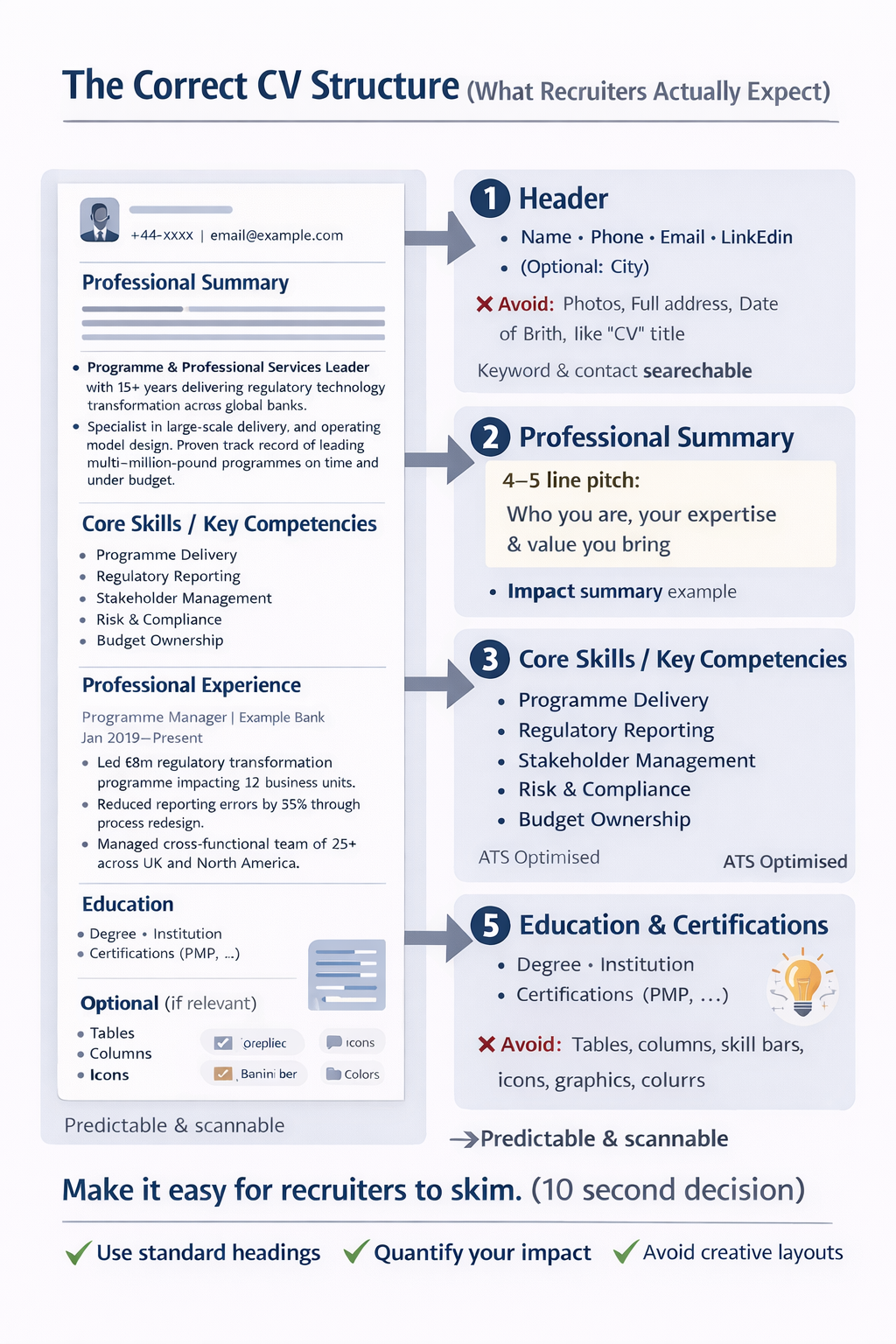
1. Header: Simple, professional, searchable
Include only:
Name
Phone
Email
LinkedIn
City/Country (optional)
Example
Leslie Wilson
London | +44 XXXX | email@email.com | linkedin.com/in/xxxxx
Why this matters
- ATS extracts contact info easily
- Recruiters find you quickly
- Looks clean and senior
Remove
❌ Photos
❌ Full address
❌ Date of birth
❌ Nationality
❌ “CV” title
These add zero value and waste space.
2. Professional Summary: Your 5-line pitch
This is NOT an objective.
It’s a positioning statement.
Answer immediately:
👉 Who are you + what level + what problems do you solve?
Formula
Title + years + domain + specialism + outcomes
Strong example (aligned with your profile)
Programme and Professional Services Leader with 15+ years delivering regulatory, compliance, and technology transformation across global banks and AI SaaS firms. Specialist in large-scale delivery, operating model design, and complex stakeholder environments. Proven track record leading multi-million-pound programmes across North America and Europe.
Why it works
In 5 seconds, recruiter knows:
- seniority
- domain
- scale
- relevance
That’s the goal.
3. Core Skills / Competencies ATS goldmine
This section is less for humans and more for software.
Think keywords, not sentences.
Format
Bullets or short columns
Example
Core Skills
• Programme Delivery
• Regulatory Reporting
• Stakeholder Management
• Risk & Compliance
• Target Operating Model (TOM)
• Budget Ownership
• PMO Setup
• Agile / Waterfall
• Vendor Management
Why this matters
This section:
- boosts ATS score massively
- helps recruiters skim fast
- shows breadth instantly
Without it → lower search visibility.
4. Professional Experience: The most important section
This is where 90% of decisions happen.
Not responsibilities.
Not duties.
Impact.
Correct format per role
Structure
Job Title | Company | Dates
1-line scope
4–6 achievement bullets
Weak version (most people do this)
- Responsible for managing projects
- Worked with stakeholders
- Supported reporting
This says nothing.
Strong version (what recruiters want)
- Led £8m regulatory transformation across 10 business units
- Reduced reporting errors by 35% through process automation
- Managed 25+ cross-functional stakeholders across UK and US
- Delivered programme 3 months ahead of schedule
This shows:
✔ ownership
✔ scale
✔ results
✔ credibility
Bullet writing formula (always use this)
Action + What + Outcome + Metric
Examples:
- Implemented risk governance framework reducing audit findings by 40%
- Automated reporting saving 200+ hours annually
- Delivered £5m programme under budget by 12%
Metrics = trust.
If there are no numbers, it feels vague.
5. Education & Certifications
Recruiters skim this in seconds.
Include:
Degree
Institution
Certifications (PMP, Prince2, etc.)
Don’t include:
❌ Modules (unless early career)
❌ Coursework (unless early career)
❌ Grades (unless early career)
Senior candidates especially should keep this minimal.
Experience matters more.
6. Optional sections (only if relevant)
Add only if they strengthen credibility:
✔ Tools & Technology
✔ Publications
✔ Languages
✔ Professional memberships
✔ Board/volunteer leadership
If it doesn’t sell you, delete it.
Space = valuable.
7. Length rules (important)
Guidelines
NO MORE THAN 2 PAGES
Cut ruthlessly.
8. Visual & formatting rules recruiters love
Fonts
Calibri / Arial / Helvetica
Size 11–12
Layout
Single column
Left aligned
Bullet points
White space
Avoid
❌ tables
❌ columns
❌ graphics
❌ skill bars
❌ icons
❌ colours
Remember:
Clarity beats design. Every time.
The Recruiter Test (brutally honest)
Hand your CV to someone.
Give them 10- 20 seconds.
Ask:
“What job level am I? What do I specialise in?”
If they can’t answer instantly → rewrite → restyle.
Final mindset shift
Your CV isn’t a biography.
It’s a sales pitch
Not:
“What have I done?”
But:
“Why should you interview me over 200 other people?”
Structure makes that answer obvious.
Before submitting your CV for applications
READ IT AND ASK YOURSELF, WILL YOU HIRE THIS PERSON!!.
Leave a Reply